



WapiPay has added an Alipay payment route for Kenyan businesses buying from suppliers in mainland China, with customers funding payments in shillings and suppliers receiving yuan. The announcement puts the cost of moving money alongside the cost of moving goods.
For an importer, the attraction is a payment path that does not require the customer to use a dollar conversion as the visible intermediate step. Whether that produces a better commercial result still depends on the quoted exchange rate, fees, delivery conditions and the amount the supplier actually receives.
TechCabal reported the partnership on 19 November 2026. Its account says the initial service covers Kenya-to-mainland-China payments. The announcement should not be read as confirmation that the same Alipay corridor is already available to Nigerian importers.
Table of Contents
What the WapiPay Alipay route changes
The partnership adds another China-facing payment option to WapiPay’s existing work with WeChat Pay. TechCabal reports that the companies are starting in Kenya, with wider Asian trade among their ambitions. An expansion ambition is different from a list of routes already available to customers.
The direct commercial question is simple: can an importer settle a yuan invoice with less expense or friction than the options they use today? Removing a visible currency leg may help, but it does not automatically establish the cheapest final price.
A payment provider such as WapiPay still needs to source the destination currency and operate the settlement route. Those costs can appear in an exchange-rate margin, a separate transfer charge or both. The useful comparison is therefore the complete quote, rather than the number of currencies named in the marketing.
This is why the WapiPay announcement matters without needing a claim of universal savings. More payment options can give businesses another quotation to compare and another operational route to assess. The benefit becomes measurable when the final payout and the full cost are known.
The report does not provide a complete public tariff for every invoice size. A merchant should request a live WapiPay quotation for the actual recipient and route. A promotional example or an old social-media price is a weaker basis for budgeting a shipment.

Compare the yuan delivered, not just the transfer fee
WapiPay’s public website describes a product designed to show rates, payout methods and delivery information before confirmation. It also presents business tools for approvals and reconciliation. Those are company descriptions; a customer should check what is available on the specific corridor they are using.
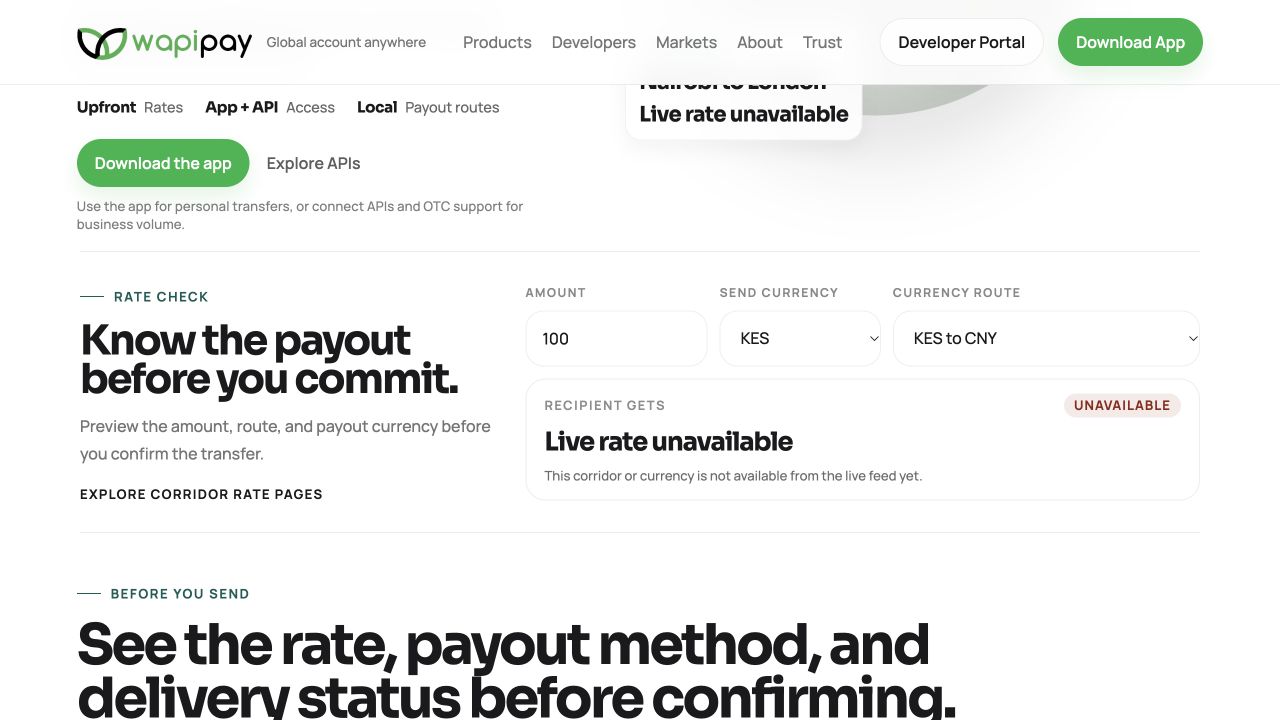
During Tomzytec’s check on 19 November, the public WapiPay preview returned no live rate with KES-to-CNY selected. This shows a limitation of the public preview at that moment, not proof that the announced service cannot process a verified business payment. Request an actual quotation before budgeting a transfer.
For a supplier invoice, start with the destination amount. If the supplier must receive a stated number of yuan, compare how many shillings leave the business account to achieve that result. This keeps a small transfer fee from hiding a less favourable exchange rate.
A useful effective-cost calculation is total shillings debited divided by yuan delivered. That ratio includes more of the real transaction than a headline fee alone. It is a comparison method, not a current WapiPay exchange rate or a prediction of currency movements.
The timing of the comparison matters too. Exchange rates move, so quotes collected on different days may reflect the market as well as the provider’s pricing. Ask how long a quote remains valid and what happens if funding reaches the provider after it expires.
WapiPay’s new route should be assessed against alternatives on the same basis: recipient, amount, currency and delivery conditions. An individual wallet transfer and a documented business supplier payment may have different requirements, even when both ultimately send money to China.
An importer should also establish whether the recipient receives the full requested amount or whether another charge is deducted before delivery. A short payment can create a second transfer, another conversion and a delay in releasing goods. That operational cost matters even if the first transaction looked inexpensive.
A payment route does not verify the supplier or the shipment
Adding Alipay as a payout route addresses how a payment may reach a recipient. It does not, on its own, verify the quality of goods, confirm a shipment or replace the commercial agreement between buyer and supplier.
Before paying, the importer needs a clear invoice, the correct legal counterparty and recipient details that match the agreed arrangement. If a beneficiary suddenly changes, confirm the change independently through a trusted contact method established earlier. Treating a payment screenshot as proof of a supplier’s identity is not enough.
The same separation applies to buyer protection. A service supporting a particular wallet does not automatically mean that every supplier payment carries the dispute rights of a consumer purchase. Ask WapiPay which contractual terms govern the transaction and which party handles a failed payout.
WapiPay may provide visibility into the movement of funds, but that is different from visibility into the movement of goods. Importers still need shipment references, delivery terms and a process for resolving product disagreements.
This distinction is particularly important for businesses trading through messaging apps. The invoice, purchase order and payment reference should remain connected in the business records. A successful payout is one stage of a transaction, not a complete audit trail for the purchase.
Tomzytec’s business email guide is relevant to keeping supplier communications organised. A consistent business mailbox can help retain records, but it cannot substitute for checking an invoice or independently confirming a beneficiary change.

Delivery, limits and refunds deserve attention before funding
A route can offer an attractive quotation and still be unsuitable for an urgent shipment if its operating conditions are unclear. Ask WapiPay when the delivery clock starts: at payment creation, after funds are received, or after verification has been completed.
WapiPay’s website describes verification and monitoring controls as part of its service. Merchants should therefore expect that identity, business or transaction documents may affect when a payment can proceed. The requirements for an actual transfer should be confirmed with the provider, rather than inferred from a general product page.
Limits also matter. An importer splitting an invoice into several payments may create extra fees and more reconciliation work. Confirm WapiPay’s relevant limits and documentation before deciding that a route fits the invoice.
Refunds require the same attention as successful payouts. Ask WapiPay what happens if the destination account cannot receive the funds, which currency comes back and whether exchange-rate changes or third-party deductions can affect the returned amount. These are questions to resolve, not published promises about this new route.
WapiPay’s expansion into another China payment channel is therefore both a pricing story and an operations story. For a business trying to keep stock moving, a clear exception process can be as valuable as a small difference in the quoted fee.
An internal approval record also helps separate purchasing from payment authorisation. The person checking a supplier invoice should be able to see the beneficiary, amount, reference and final debit before a transfer is released. That principle applies across payment providers.
What Nigerian importers can take from the announcement
The initial Alipay arrangement reported by TechCabal is specific to Kenyan funding and mainland China recipients. Nigerian businesses should not assume that a WapiPay presence in another service category means they can use this exact corridor on identical terms.
The broader lesson is still relevant. An importer in Lagos, Ilorin or another Nigerian city benefits from separating the invoice currency, the funding currency and the total landed cost of goods. The cheapest visible payment fee does not necessarily produce the cheapest stocked item.
Freight, insurance, duties, handling and the treatment of a delayed shipment remain separate from the payment provider’s charge. A stronger transfer route can improve one part of the process without eliminating the other expenses.
Tomzytec’s OPay and SunTrust partnership report covers a different layer of payment infrastructure inside Nigeria. The common thread is that a technical partnership needs to be translated into specific customer terms before a business can judge the benefit.
For WapiPay, the next useful evidence will be clear route availability, a reproducible quote and documented delivery performance. Those are stronger indicators of merchant value than a broad claim about the size of Africa–Asia trade.
Questions about the WapiPay Alipay partnership
Does the agreement remove every dollar cost? The reported customer route allows shilling funding and yuan receipt. It does not disclose every part of the provider’s treasury operations. The customer should compare the final quotation rather than infer the provider’s entire foreign-exchange process.
Is every Chinese supplier eligible? Confirm the recipient type and account requirements with the provider. A general announcement about Alipay support is not a guarantee that a particular beneficiary will pass verification or receive a particular invoice amount.
Can Nigerian businesses use the same service immediately? The reported initial scope is Kenya to mainland China. A separate confirmation is needed for Nigerian funding, pricing, documentation and availability.
Has Tomzytec tested a transfer? No. This report combines the announced partnership, WapiPay’s public service descriptions and an explanation of how merchants can compare costs. It does not claim a completed transaction or independently measured savings.
Final Thoughts
The WapiPay Alipay deal creates another possible route for Kenya–China trade payments. Its practical value will come from the amount delivered, the complete cost and the reliability of the process when a shipment depends on it.
For merchants, the next step is a documented quote and clear recipient requirements. More choice is useful; a price and a delivery promise that can be checked are what turn that choice into a business decision. The photographs in this report are licensed illustrations of trade and business administration, not company portraits.






Leave a comment