



The Takealot marketplace is offering South African small businesses access to a retail network built over more than a decade. The opportunity is reaching customers through established technology and delivery infrastructure; the business question is whether each seller can earn a sustainable margin after the associated costs.
TechCabal’s report published today says the platform has more than 16,000 independent sellers. It follows comments by Takealot Group chief executive Frederik Zietsman at Africa Tech Festival in Cape Town about the role of e-commerce infrastructure in supporting smaller businesses.
The scale is significant, but access to a marketplace should not be confused with a guarantee of profitable sales. Tomzytec checked Takealot’s public seller page to separate the platform’s growth story from the costs and decisions a prospective merchant still needs to understand.
Table of Contents
The Takealot marketplace offers infrastructure as well as traffic
Takealot combines a digital storefront with systems for stock, orders, fulfilment and delivery. A small business can use that infrastructure without first building an online retail operation of comparable scale.
TechCabal reports that Takealot served more than six million active customers and processed over 60 million orders in its last financial year. Those are figures about the wider business. They do not tell a new seller how many people will see its particular listing or buy its product.
The distinction is easy to lose in marketplace marketing. A large audience creates potential reach; demand for a particular item still depends on its price, usefulness, availability, presentation and competition.
For a business with a good product but limited delivery capacity, the Takealot marketplace may reduce the need to assemble every part of an online operation itself. For a business already serving customers efficiently, the calculation is whether the additional reach justifies the fees and operating requirements.
A seller should therefore begin with the economics of its own products. A platform’s national order volume is useful context, not a substitute for a forecast based on a particular category and a realistic selling price.

Official seller fees make the cost question concrete
Takealot’s official seller page lists a R400 monthly subscription per seller account, excluding VAT. It also identifies success fees, fulfilment fees and storage charges, with a free-storage threshold and charges for overstocked units.
The page directs sellers to a fee calculator. That matters because the subscription is only one part of the bill. Product category, size, fulfilment arrangements and stock behaviour can affect the amount a seller needs to allow for.
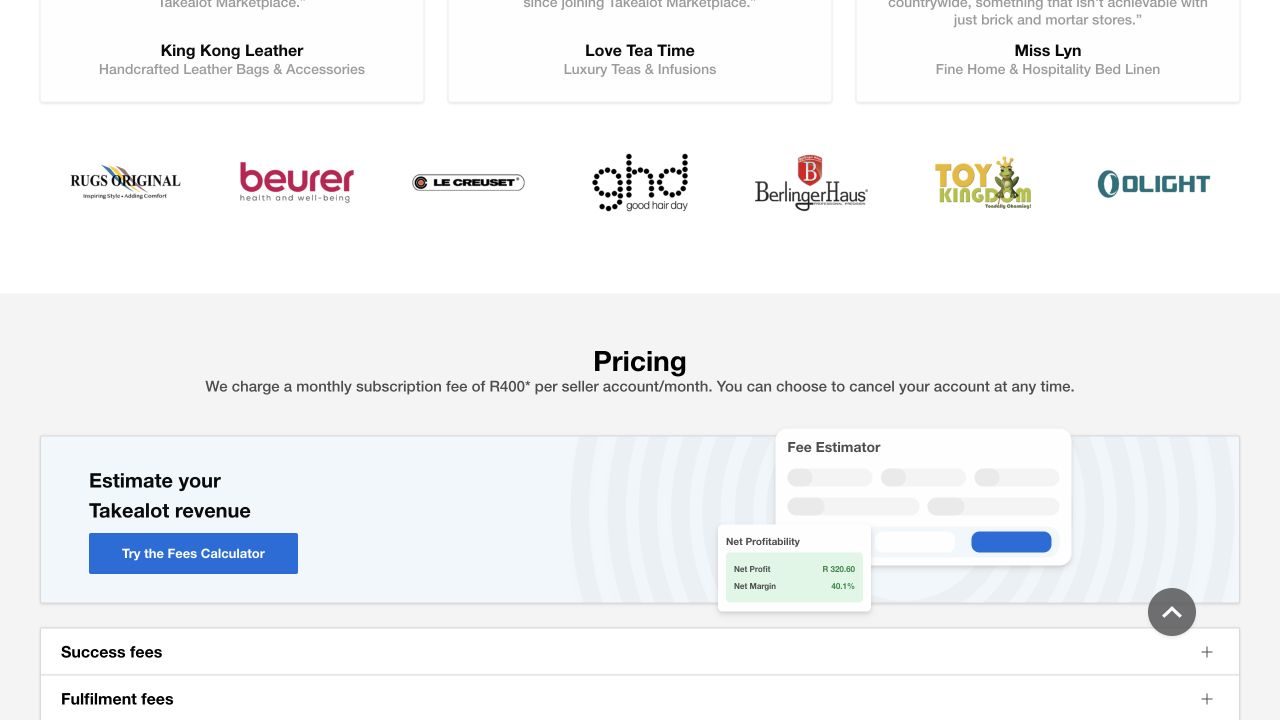
Before joining the Takealot marketplace, a business should model a specific item rather than divide its expected revenue by a headline commission percentage. Use the actual category, dimensions and selling arrangement, and include the costs of producing or acquiring the product.
Packaging and moving stock into the required fulfilment process can also change the economics. A business that normally hands an item to a nearby customer may face a different cost structure when it sells the same item nationally.
The R400 subscription also has a different effect at different sales volumes. Spread across 100 units sold in a month, it represents R4 per unit before VAT. Spread across ten units, it represents R40 per unit. This arithmetic allocates the subscription only; it is not a complete fee estimate.
That simple example explains why a profitable product at one volume can become unattractive at another. The Takealot marketplace gives a seller access to infrastructure, but the seller still carries the consequences of its own demand assumptions.
A useful margin model starts after all the obvious deductions
Consider a purely illustrative product sold for R500. Suppose its acquisition cost is R200, selling and fulfilment costs together are R100, packaging and inbound handling are R30, and the seller allows R20 for returns or other expected adjustments. The remaining contribution would be R150 before subscription allocation, overheads and tax.
These are invented example inputs, not Takealot’s actual rates for a product category. Their purpose is to show why a R500 sale cannot be treated as R500 of earnings. Replace every assumption with the business’s own costs and the current fee quotation.
If only ten units sell in a month, allocating the R400 subscription would reduce that illustrative R150 contribution by R40 per unit. If 100 units sell, the allocation is R4. The outcome can change without any change in the product’s selling price.
A seller also needs to distinguish cash flow from accounting margin. Stock may be paid for before it sells, while proceeds arrive on the platform’s payout schedule. A business can show a positive margin on paper and still struggle to fund replenishment.
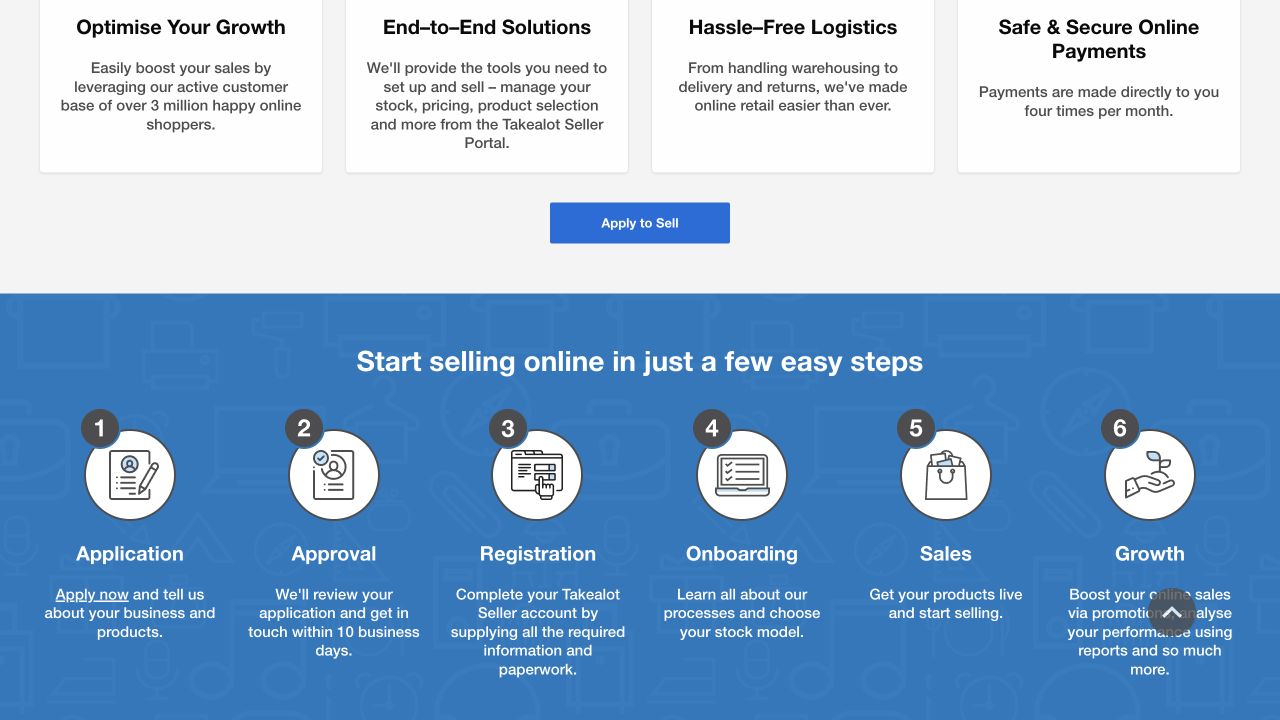
Takealot’s public seller page says payments are made four times per month. A merchant should confirm the current settlement terms, deductions and reconciliation process during onboarding. A general payout frequency does not mean every order becomes usable cash immediately.
The Takealot marketplace is most useful when these figures are visible before stock is committed. A fee calculator, a realistic sales forecast and an allowance for slow-moving stock make the opportunity easier to assess than a broad promise of growth.
Fulfilment can remove work while introducing new obligations
TechCabal’s account describes Zietsman’s explanation that Takealot invested in its own logistics after earlier providers struggled with its requirements. The underlying lesson is that reliable delivery is part of the product customers buy, not an administrative detail added at the end.
For smaller merchants, established fulfilment can reduce the work of arranging each individual delivery. It can also provide processes for returns and customer service that would be expensive to build independently.
The trade-off is working to the platform’s requirements. Product information, stock availability and preparation need to be accurate. A listing that attracts orders for unavailable stock can create customer disappointment even when the wider delivery network functions well.
The Takealot marketplace also makes inventory discipline important. Too little stock can lose a sale; too much stock can tie up cash and expose the business to storage costs. A national platform does not remove the need to know which products move and which do not.
For a manufacturer, that may mean starting with a limited range whose costs and production reliability are understood. For a reseller, it means knowing whether a supplier can replenish stock at the assumed cost. These are commercial planning considerations, not a claim that any one strategy guarantees success.
Customer trust depends on the complete chain. The item needs to match its description, arrive in the expected condition and have a clear route for resolving a problem. Strong logistics cannot fully compensate for inaccurate product information.
Technology investment needs a measurable seller benefit
The TechCabal report also describes Takealot’s use of AI in demand prediction and software development, as well as operational data used to identify problems across the delivery journey. These are company explanations of its approach, rather than independent evidence that every seller receives the same improvement.
For a merchant, the relevant outcomes are practical: fewer errors, better availability, a manageable cost per order and clearer information about what is selling. The presence of AI is less important than whether those results improve.
The Takealot marketplace can generate useful sales information, but sellers need to interpret it alongside their own margins. A popular item may produce little contribution, while a lower-volume product may be healthier after fulfilment and stock costs.
The same discipline applies to promotions. A discount can increase orders while reducing the money retained from each one. Before joining a campaign, work through the price, fee and stock implications rather than judging it only by the expected traffic.
Tomzytec’s business email guide covers a simpler part of digital operations: keeping a dependable channel for customers and partners. Whether a business sells through a platform or its own site, accurate records and clear communication still support the operation.
The wider lesson for Nigerian and African small businesses
This is a South African marketplace story. A Nigerian business should not infer that it can start selling on identical terms without checking the platform’s current eligibility, documentation, stock and settlement requirements.
The transferable lesson is the value of shared infrastructure. A small merchant may be able to reach a wider market by using an existing platform, but it gives up some control over the surrounding process and accepts a new set of costs.
That calculation also appears in payment infrastructure. Tomzytec’s WapiPay Alipay report explains why a new route needs to be judged by its complete cost and operating conditions. Retail platforms require the same attention to the actual result for the business.
For the Takealot marketplace, the next meaningful evidence is how independent sellers grow profitably, rather than simply how many accounts join. Seller retention, sustainable contribution and reliable fulfilment would say more about the opportunity than a registration count alone.
Questions prospective marketplace sellers should resolve
Is R400 the complete monthly cost? No. The public seller page also lists success, fulfilment and potential storage fees, with fees quoted excluding VAT. Use the current calculator and terms for the specific product and stock model.
Does access to millions of customers guarantee sales? No. Platform reach and a particular listing’s demand are different measures. Product selection, competition and pricing still matter.
Is this a new open grant or a funding programme? No. The story concerns a commercial marketplace and its infrastructure. It should not be confused with an application for free business finance.
Final Thoughts
The Takealot marketplace gives independent sellers access to substantial retail infrastructure. That can be valuable, particularly when a business would struggle to build national fulfilment and customer reach by itself.
The stronger decision comes from working through the product-level figures before committing stock. Reach creates an opportunity; a positive margin and dependable operations make it sustainable. The real stock photographs here illustrate seller administration and warehousing, not a Takealot facility or the conference session.







Leave a comment