


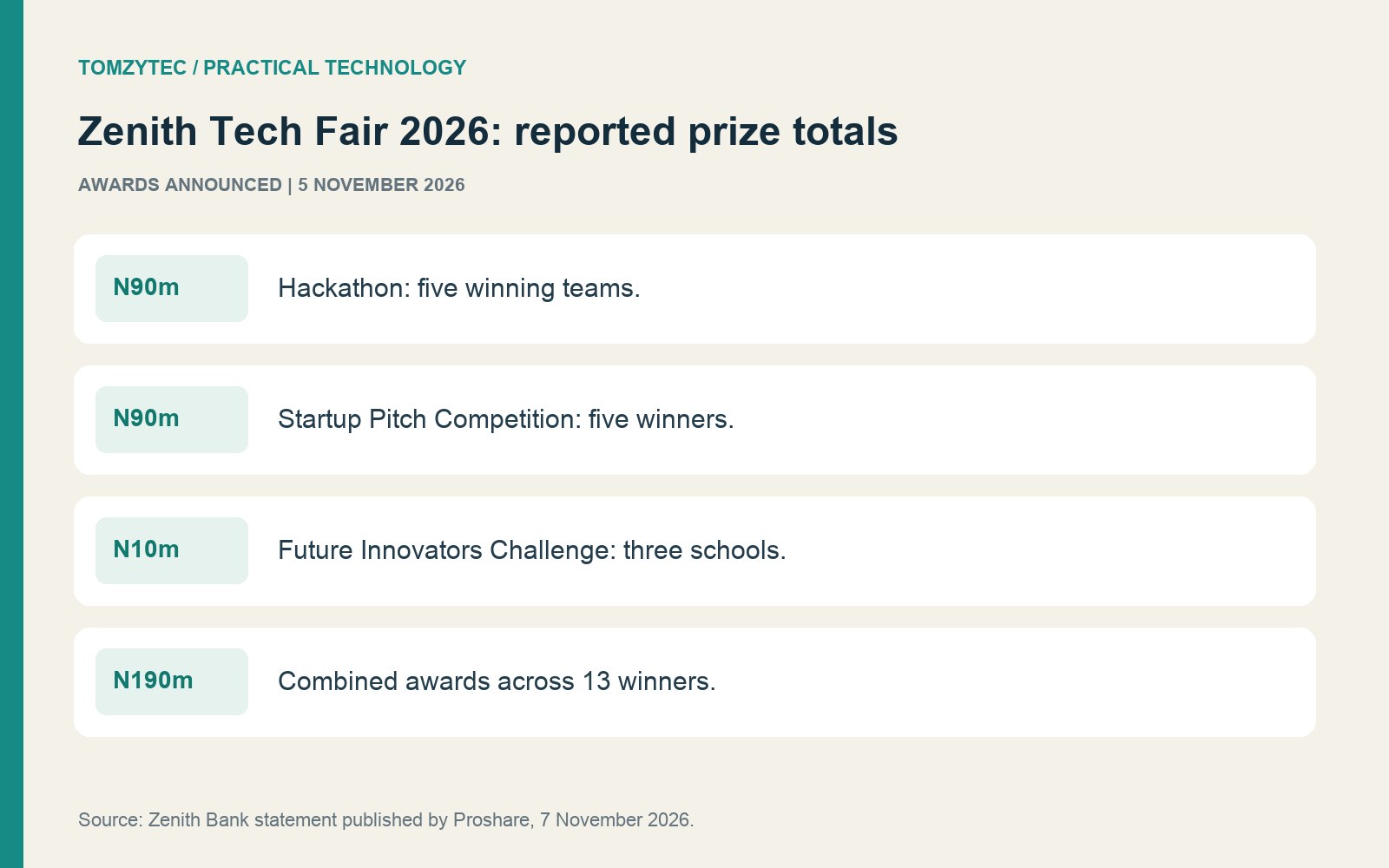
Zenith Bank has awarded ₦190 million to 13 winners at its 2026 Tech Fair, backing projects from developers, startups and secondary-school innovators. The event took place virtually on 5 November 2026, according to the bank’s statement published by Proshare on 7 November.
The results bring a practical mix of projects into focus: tools for businesses, solutions in education and healthcare, and ideas developed by younger learners. For aspiring Nigerian founders, the useful question is how to turn a project into something that can be demonstrated and assessed.
Three competitions shared the awards
The Zenith Bank statement published by Proshare lists three categories: Hackathon, Startup Pitch Competition and Future Innovators Challenge. It says the competitions attracted more than 3,000 submissions. The award totals come from the organiser; they are not a measure of the winners’ future commercial performance.
Team Solo led the Hackathon with ₦35 million. Cutstruct Technology Limited took first place in the Startup Pitch Competition, also receiving ₦35 million. Caleb British International School won the school-focused Future Innovators Challenge and received ₦5 million.
What the winning projects show
Reporting by African Press Agency also records the 13 winners and their awards. In the startup category, Sproutly and PharmaRun followed Cutstruct; the school challenge recognised Queen of the Rosary College, Onitsha, and Regina Pacis International School alongside Caleb British International School.
The spread matters because learning technology is not limited to building another social app. A useful project can begin with a narrow problem in a school, a shop or an existing business process. The important test is whether someone can understand the need and see how the proposed solution addresses it. That is Tomzytec’s interpretation of the results, rather than a claim that every winning project has already proved its impact at scale.
Funding is one part of the next stage
The bank says the winners will also receive a six-week mentorship and incubation programme. Such support gives teams a period in which to review their product and business decisions, but an award should not be confused with proof of customer demand or a guarantee that a company will succeed.
The next milestones worth watching are practical ones: working products, reliable delivery, user feedback and evidence that the solution remains useful after the competition. Those results will take time to establish.
What beginners can learn from this
If you are building your first project, choose a problem you can describe in plain language. Create a small working version, keep a record of what you changed, and test it with someone who was not involved in building it. Be clear about which parts are complete and which are still experimental.
Our beginner GitHub portfolio guide explains how to document that work. For readers looking for structured training, our Ilorin tech-skills guide offers options to investigate directly with the providers.
This is a completed competition, not an open application
These reports concern awards already announced at the 2026 event. They do not establish an open application window for another round. Anyone interested in a future competition should look for a fresh announcement through Zenith Bank’s official channels and check the eligibility rules and deadline there.
Why this matters
The awards bring funding and visibility to a range of technology projects, including work by secondary-school students. The longer story will be what the teams build next. For readers still learning, the immediate lesson is to develop a project that can be explained, demonstrated and improved through feedback.







Leave a comment